Pages

Sunday, May 21, 2017

Rolle's Theorem and the Mean Value Theorem

Hi everyone! I hope you all had a great weekend. Rolle's Theorem and the Mean Value Theorem are two theorems of Calculus that can seem similar in a way, as they share a common hypothesis. Today, we will explore what these theorems state and examine interesting problems that could be approached with these theorems.

First, let's go over what the theorems state!
1> Rolle's Theorem:
If function f is continuous on the closed interval [a, b], differentiable in the open interval (a, b) and
f(a) = f(b), there exists a number c in (a, b) such that f '(c) = 0.

2> Mean Value Theorem (MVT):
If function f is continuous on the closed interval [a, b] and differentiable in the open interval (a, b), there exists a number c in (a, b) such that f '(c) = {f(b) - f(a)} /( b - a)

Now, let's look at some example problems.

Example 1> Prove that x^3 + x - 1 = 0 has exactly one zero.

Solution> First, we have to use the Intermediate value theorem to prove that there is a zero. For those of us who are not familiar with the Intermediate Value Theorem (IVT), the IVT states that if f is continuous on [a, b] and f(a) < w < f(b), there exists a number c between a and b such that f(c) = w. Let f(x) = x^3 + x - 1. Since f is a polynomial function, it is continuous on its domain (-∞, ∞). Thus f is continuous on [0, 1]. Notice f (0) = -1, f (1) = 1. Thus by the IVT, there exists a number c in (0, 1) such that f (c) = 0. Now, we will use proof by contradiction. Suppose that x^3 + x - 1 has two zeros at a and b. Without loss of generality, let a < b. x^3 + x - 1 is continuous on [0, 1] and since f '(x)= 3x^2 + 1 and this is never undefined, f (x) is differentiable in (0, 1). Since a and b are zeros, f(a) = f(b) = 0. Therefore, by Rolle's Theorem, there exists a number d in (0, 1) such that f '(d) = 0. But, f '(x)= 3x^2 + 1 ≥ 1 and this is a contradiction. Therefore, our hypothesis that f has two zeros were incorrect and therefore we have exactly one zero.

Example 2> Suppose that f(0) = -3 and f '(x) ≤ 5 for all values of x. How large can f (2) possibly be?

Solution> Since f is differentiable in (-∞, ∞), f is continuous in (-∞, ∞), and thus f is continuous on [0, 2]. Therefore, by the Mean Value Theorem, there exists a number c in (0, 2) such that f '(c) = {f(2) - f(0)}/2 = ( f(2)+ 3 )/2 ≤ 5. So, f(2) ≤ 2*5 - 3 = 7. Therefore, the largest f (2) can possibly be is 7.

I just wanted to introduce you all to these theorems and set of questions, because I was intimidated by these proof type questions using these theorems when I saw them. I was confused as of when to use the MVT, IVT, or Rolle's Theorem. Familiarity with the theorems are crucial, and it is important that we remember how to approach each of these problems using the theorems. I hope you all have a great rest of the day and please contact me if you do have any questions.
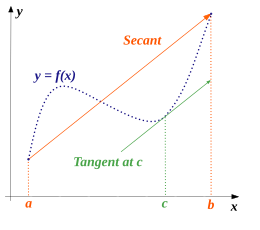
Mean Value Theorem; for a given arc between two endpoints,
there is at least one point at which the tangent to the arc is parallel
to the secant through its endpoints.

Sunday, May 14, 2017

Understanding Early Number Systems


Hi! I apologize for not being able to post for the past few weeks; I was a little busy with all the AP testing, but I hope you all had a wonderful weekend and...
In this post, we will be exploring the basic idea and patterns behind some of the earliest number systems!


The Egyptians and the Babylonians are known to have come up with one of the first number conventions. These conventions often used symbols that represented specific numbers, known as “Nodal numbers.” Other numbers would be formed by grouping nodal numbers together in certain way. This system is known as the “Additive System.”


The Egyptians adopted this system in their number conventions. For example, in ancient Egyptian notation, the numbers 1, 2, 3, 4, 5, 6, 7, 8, 9, 10, 19, 40 would be represented by:


From this notation, we can observe that 1 and 10 were nodal numbers; 1 would be represented by a vertical dash, while 10 would be represented by a symbol that looks like an upside-down U.


The Babylonians used 1, 10 and 60 as their nodal numbers. The Babylonians used a sexagesimal positional number system, in which the value of a particular digit depends both on the digit itself and its position within the number. It has been proposed that 60 was used as the base number, as 60 = 2^2 x 3 x 5, which makes it divisible by 1, 2, 3, 4, 5, 6, 10, 12, 15, 20, and 30.


Other Fun Facts:
  • The Babylonians understood the concept of nothingness, but it was not seen as a number. The Babylonians understood “nothingness” as absence of a number, and thus represented nothingness with a space at first. Later on, a placeholding symbol was used to show the nonexistence of a digit in a certain place value.
Babylonian digit 0.svg
This is the placeholding symbol
used by the ancient Babylonians to
represent 0.

  • Nodal numbers are also used in Roman Numerals, in which many of us are familiar with. In the Roman number system the nodal numbers are 1, 5, 10, 50, 100, 500, 1000, represented respectively by the signs I, V, X, L, C, D, M. 1, 2, 3, 4, 5, 6, 7, 8, 9, 10, 19, 40 would be represented by I, II, III, IV, V, VI, VII, VIII, IX, X, XIX, XL in Roman numerals.


I hope you all enjoyed this post, and please contact me if you have any questions!


Sources:


Saturday, April 8, 2017

The Shoelace Formula- Example Problem

Hello, in this post we will see a very simple example problem using the Shoelace Formula, a topic about which I posted last time. In this example, we will be finding the area of a triangle given the coordinates of its three vertices. I hope that this example will make the usage of this method more clear for you all!


Monday, April 3, 2017

The Fields Medal

Hello everyone! I think you all have heard at least once about the Fields Medal. Well in this post, I will be sharing information about this very prestigious award!

The Greek mathematician Archimdes (B.C.287~B.C.212) was
engraved onto the medal along with the Latin verse,
"TRANSIRE SVVM PECTVS MVNDOQVE POTIRI."
The Fields Medal is considered one of the most prestigious awards in mathematics; often times, it is viewed as a “Nobel Prize” in the field of mathematics. The Fields Medal is a prize awarded to two, three, or four mathematicians under 40 years of age at the International Congress of Mathematicians (ICM) hosted by the International Mathematical Union (IMU), a meeting that takes place every four years.

The prize comes with a monetary award, which since 2006 has been C$15,000 (Canadian Dollars). This award was named “Fields,” in the honour of the Canadian mathematician and Professor of the University of Toronto, John Charles FIelds, who played a key role in establishing the award, designing the medal, and funding the monetary component.
The medal was first awarded in 1936 to the Finnish mathematician Lars Ahlfors, who was "Awarded medal for research on covering surfaces related to Riemann surfaces of inverse functions of entire and meromorphic functions. Opened up new fields of analysis." and to the American mathematician Jesse Douglas who "Did important work of the Plateau problem which is concerned with finding minimal surfaces connecting and determined by some fixed boundary." The medal has been awarded every four years since 1950.

This medal was created to give recognition and support to younger mathematical researchers who have made major contributions, and the latin words “TRANSIRE SVVM PECTVS MVNDOQVE POTIRI” on the medal means “Exceed above oneself and grasp the world.”

Sunday, April 2, 2017

The Shoelace Formula


Hi, today I will introduce you all to the Shoelace Formula, which is also known as Gauss’s Area Formula. This formula would provide a quick and easy way to find the area of a triangle given the coordinates of the triangle. Since this formula would be hard to explain without an appropriate visual, I added in a picture with a diagram of a triangle along with a summary of steps. Make sure you refer to this picture as you read the explanations for each step :)
Step 1: Write down all the x and y coordinates in a manner shown in “Step 1” in the picture. Note that one of the coordinates will have to be written twice. The order in which you list the coordinates do not matter.
Step 2: Starting on the x coordinates, draw an arrow moving down diagonally (depicted with pink lines). Starting on the y coordinates, draw an arrow moving up diagonally (depicted with blue lines).
Step 3: Multiply the pair of values that are tied by a line. For the values that were connected with a pink line, place them in the absolute value without changing their signs and for values that were connected with a blue line, place them in the absolute value with an opposite sign (in other words, add a negative sign).
I apologize if my explanation was a little confusing or vague, but in my next post, I will put up an example and you guys will see how convenient and quick this formula can be in some cases. There are so many different ways to find the area of a triangle. However, when you are only given the coordinates of each vertex, the Shoelace Formula would most likely be the most convenient. For instance, if we tried to use the traditional 1/2 times bases times height, it would be hard to find the height. If we tried to use Heron's formula, we would have to start out by finding the lengths of each sides (which is possible, of course, using the distance formula), which can be very time consuming. In my Calculus class, we approached this same problem using concepts of Calculus; we applied the method of finding area between two curves, and this process to turned out harder and more time consuming. So I hope you all find this method helpful!! Have a great restful day!


Pi Facts

Hey guys! Today I will introduce some interesting facts about Pi (𝝅), an irrational number defined as the ratio of the circumference of a circle to its diameter.
  1. 39 decimal places of pi are enough to compute the circumference of a circle the size of the known universe with an error no greater than the radius of a hydrogen atom.
  2. “Pi Day” is celebrated on March 14, and the official celebration begins at 1:59 PM, to form 3.14159 when written together with the date.
  3. The symbol for pi (π) has been used regularly in its mathematical sense only for the past 250 years.
  4. Egyptologists and followers of mysticism have been fascinated for centuries by the fact that the Great Pyramid at Giza seems to approximate pi. The vertical height of the pyramid has the same relationship to the perimeter of its base as the radius of a circle has to its circumference.
  5. The first 144 digits of pi add up to 666 (which many scholars say is “the mark of the Beast”). And 144 = (6+6) x (6+6).
  6. Pi is also referred to as the “circular constant,” “Archimedes’ constant,” or “Ludolph’s number.”
  7. Albert Einstein was born on Pi Day (3/14/1879) in Ulm Wurttemberg, Germany.
I apologize for not being able to post this before Pi Day, but Pi facts are always good to know! I hope you all found these facts interesting as much as I did! Have a great rest of the day!


Thursday, March 23, 2017

The Apollonius Theorem

Post 2: The Apollonius Theorem
Hello, I hope you all had a great day! In this post, we will be exploring the Apollonius Theorem, which can be thought of as a special case of the Stewart Theorem. The Apollonius Theorem will relate the length of the median of the triangle to the length of its sides. The Apollonius Theorem states that the sum of the squares of any two sides of any triangle equals twice the square on half the third side, together with twice the square on the median bisecting the third side. So, in other words, c^2+b^2=2(m^2+d^2) in the diagram below. Like the Stewart Theorem, we will prove this theorem using the law of cosines.


<Proof>
b^2=m^2+d^2+2dmcos𝜃  ….①
c^2=m^2+d^2+2dmcos𝜃’ (<= cos𝜃=cos𝜃’ since 𝜃 and 𝜃’ are supplements)
=m^2+d^2 - 2dmcos𝜃 ….②
① + ② yields
b^2+c^2=2(m^2+n^2), which is the Apollonius Theorem.
